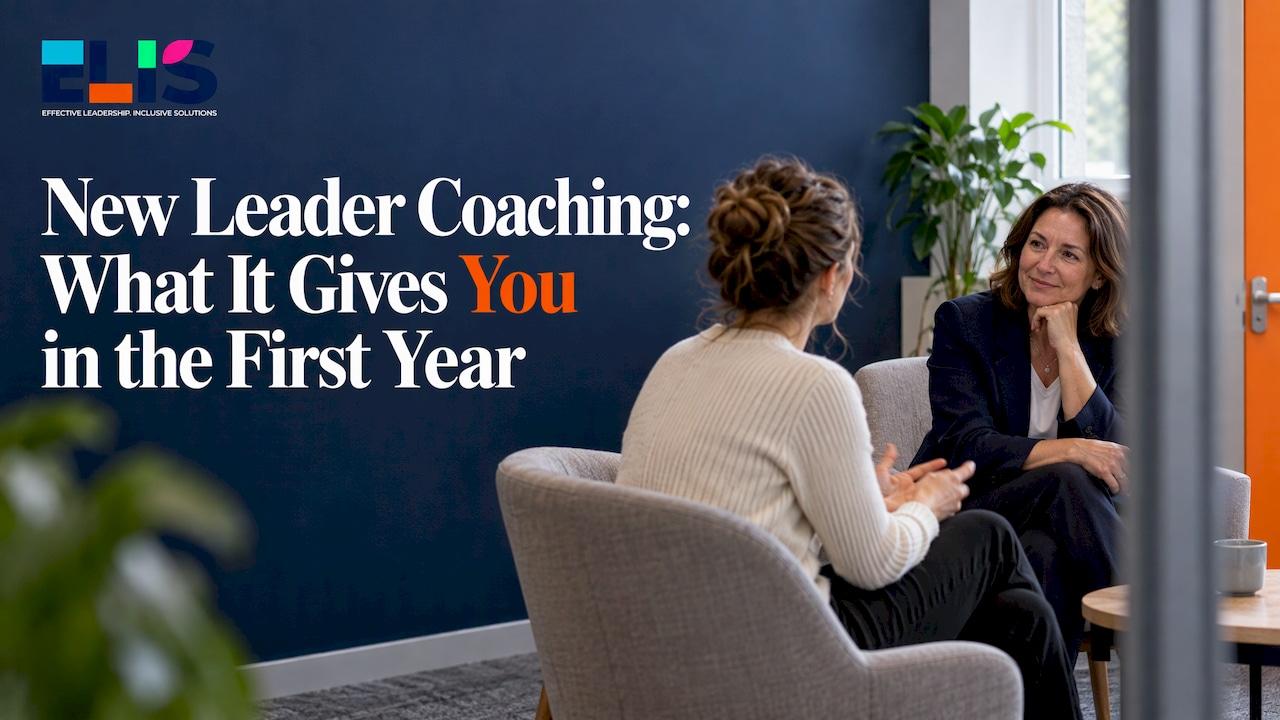
Coaching for a new leader gives you a confidential, structured space to work out how to lead in the role while you are doing it. You get a skilled partner who asks the right questions, helps you read your new relationships and keeps your goals in view as the pressure builds. At ELIS Advantage we coach senior leaders through this transition, and our leadership coaching process starts from your role, your team and your organisation, not from a generic programme.
This guide is for newly appointed senior leaders, the CEOs and COOs who appoint them, and the HR directors who arrange support. It explains what new leader coaching is, what it helps with, how an engagement runs and how to set it up so the learning lasts.
Key Takeaways
- Coaching is a professional, one-to-one process built on listening and questioning, so the answers you reach are your own and fit your context.
- Research on newly appointed senior leaders links coaching with less feeling of overwhelm, clearer expectations and better working relationships.
- A good engagement has a clear contract, regular sessions and a final review that turns progress into an action plan.
- Most leadership learning happens on the job, so coaching works best when it is tied to real decisions and real conversations.
- Organisations get more from coaching when line managers, HR and the leader agree the goals at the start.
Table of Contents
- What coaching means for a new leader
- The challenges coaching helps with
- Confidence, presence and inclusive habits
- How a coaching engagement runs
- Making the most of the first 90 days
- How HR and senior teams can support the leader
- What to look for in a leadership coach
- Coaching with ELIS Advantage
- Our perspective
- FAQ
- Sources
What coaching means for a new leader
Coaching is a professional relationship that helps a person learn, perform and develop. The coach listens and asks questions rather than giving instructions. UCD describes coaching in just these terms: facilitating learning through listening and questioning, not advising.
For a new leader, the focus is the move itself. The Central Bank of Ireland's coaching policy names assuming a new leadership role as one of the moments when individual leadership coaching is available to its senior leaders, alongside key career transitions and periods of significant pressure. Large Irish employers already treat promotion as a point where support pays off.
A useful way to see the difference from other support:
| Support | Who leads | Main purpose |
|---|---|---|
| Coaching | You, with a coach asking questions | Your own leadership behaviours, decisions and relationships |
| Mentoring | An experienced colleague sharing what they know | Passing on experience and advice |
| Leadership training | A trainer teaching content | Building shared knowledge and skills for a group |
Academic researchers Hastings and Kane define coaching for leadership development as a formal, one-on-one, individualised process. Its aim is a better understanding of leadership behaviours and their impact. They also note that coaching has moved from fixing underperformance towards developing people with high potential for advancement. A new leader seeking coaching is making a strong, forward-looking choice.
The challenges coaching helps with
The first months in a senior role bring a particular mix of pressures. Gill Reynolds studied six newly appointed senior leaders in their first 12 to 18 months. Her study found they valued coaching for helping them move through a deep sense of vulnerability. That included feeling overwhelmed, being unsure what senior executives expected, pressure to deliver quickly and a fear of being found out.
The same study found coaching helped leaders recalibrate relationships. They delegated more, held their teams to account and changed how they related to peers and senior executives. The participants also valued the calm, reflective space the coach created.
A 2025 action-research study by Simpson looked at an online group coaching programme for leaders moving into senior positions. It reported that coaching normalised the disorienting challenges of transition. Leaders came away with more clarity about what being a senior leader meant, how to engage with others and how to lead in the role.
In practice, these themes show up as questions you may recognise:
- How do I move from being the best at the work to leading others who do it?
- Which of my old peer relationships need a new footing now?
- What do my executive colleagues expect from me in the first six months?
- How do I make decisions with incomplete information without second-guessing myself?
- How do I build a team culture where people speak up?
If self-doubt is part of the picture, you are in good company. Feeling like an imposter after a promotion is common among high achievers, and coaching gives you a private place to look at it with someone trained to listen well.
Confidence, presence and inclusive habits
Confidence in a new role comes from clarity: what you stand for, how you want to make decisions and how you want people to experience working with you. A coach helps you put those into words and test them in real situations, such as a first leadership team meeting or a difficult conversation with a former peer.
Presence follows the same path. It is built from consistent behaviour: how you listen, how you handle disagreement and how you respond when something goes wrong. Coaching lets you rehearse and review those moments.
Inclusive leadership habits are easiest to form early, before patterns set. Our coaching combines data-driven performance thinking with trauma-informed, anti-oppressive practice. That means we help you look at how your decisions, meetings and feedback land for different people on your team, and how to build psychological safety, the sense that people can raise concerns and ideas without fear of embarrassment or punishment. For a deeper look at the team side, see our article on leading change without leaving people behind.
How a coaching engagement runs
The Central Bank of Ireland's policy gives a clear picture of a well-run engagement, and many organisations follow a similar shape. In its process:
- The leader completes a business case, approved by their line manager.
- The Learning and Development team shortlists coaches.
- The leader meets at least two coaches in a chemistry check.
- A contracting phase agrees the number, length and frequency of sessions, the objectives and desired outcomes, roles and responsibilities, and confidentiality.
- Up to six sessions run within nine months, with progress reviewed at each one.
- The final session reviews the original objectives and produces an action plan with clear, measurable steps for assessing change over at least six months.
There are three points to take from this, whatever provider you choose.
Agree the goal first. A new leader's goal might be to build a leadership team that makes decisions well, or to establish a presence with the board. Writing it down at the start gives both of you something to measure against. Our article on improving decision-making in leadership teams shows the kind of goal that works well.
Choose the coach with care. The chemistry check matters because coaching depends on trust. Speak to your coach about how they work, what they have done in similar transitions and how they handle confidentiality.
Plan for after the last session. The action plan is where coaching becomes lasting change. Reflection is part of it, and our piece on how reflective practice improves coaching effectiveness explains how to keep that habit going.
Hastings and Kane add that much leadership coaching follows the Center for Creative Leadership's model of assessment, challenge and support. The coach helps you reflect on daily activity, make sense of assessment results, build a plan for changing behaviour and then supports you in carrying it out.
Making the most of the first 90 days

The 70-20-10 model is a popular way to think about how leaders learn. Bridgespan describes it as pioneered by the Center for Creative Leadership, resting on the belief that leadership is learned through doing. The usual reading is that around 70% of learning comes from on-the-job experience, 20% from relationships such as coaches and mentors, and 10% from formal training.
This fits new leader coaching well. Your coaching sessions connect the 70 and the 20: you bring real situations from the week, reflect on them with your coach and return to work with a plan. A simple rhythm helps:
- Before each session: note one decision, one conversation and one moment that surprised you.
- In the session: choose the topic that matters most and decide what you will do differently.
- Between sessions: try one change, and notice what happens.
As a new leader you also reset how your team works together. Practical set-up counts here. Clear channels for updates and decisions help a new leader stay visible with a team across sites, and a guide to Microsoft Teams setup for business covers the basics of organising them. Pair that with a regular team rhythm, and your coaching sessions become the place to refine it.
How HR and senior teams can support the leader
Coaching works best when the organisation backs it. HR directors and CEOs have several ways to help:
- Link coaching to the role. Share the expectations of the post so the leader and coach can work on what matters to the business.
- Protect the time. Sessions need space in the diary, and leaders who keep them tend to keep the momentum.
- Keep confidentiality clear. The content of sessions belongs to the leader. The organisation sees the agreed goals and progress, which builds the trust coaching needs.
- Involve the line manager. Both the Central Bank and UCD processes involve line-management approval, which keeps coaching connected to the wider plan. At UCD, the School or Unit usually pays, except for new Heads of School.
- Support the whole team. When the leader is one part of a wider change, executive team coaching helps the group work on shared habits too.
If you are choosing support for several new leaders, our Executive and Leadership Team Interventions bring the individual and the group together.
What to look for in a leadership coach
Whatever your route, a strong coach for a new leader offers:
- Experience with leadership transitions, so they recognise the pressures of the first year.
- A clear method, including how sessions, goals and reviews work.
- Reflective practice of their own. Coaches who receive professional supervision keep their work thoughtful and ethical. We offer professional supervision for coaches and practitioners at €150 per session.
- Respect for confidentiality and clear contracting.
- An understanding of how culture and systems shape behaviour, not only the individual.
Our article on what to look for when choosing a CEO coach goes further on this, and executive coaching benefits sets out what leaders and organisations gain. If you are a woman stepping into a senior role, see our piece on coaching for women leaders.
Coaching with ELIS Advantage
Our Effective Leadership Coaching Process starts from €2,521 one-off. For leaders who want support across the whole first year, our twelve-month programmes start from €6,252 per year. Both are tailored to you and your organisation and draw on psychological and organisational research, with a focus on inclusive leadership and systems that help people perform.

To discuss coaching for a newly appointed leader, see our leadership coaching page or get in touch.
Our perspective
New leaders often arrive with a strong record and a quiet question: how do I do this well, and as myself? We think the answer lies in joining three things that are often kept apart.
The first is the individual. Your values, habits and doubts shape how you lead, and a confidential space to explore them makes a difference.
The second is the group. A leader's work happens through a team, so we pay attention to group dynamics, how decisions are made and who gets heard.
The third is the system. Culture, policy and data tell you what is working. Our approach combines data-driven performance thinking with trauma-informed, anti-oppressive practice, so that high performance and fairness grow together.
That is why we offer leadership coaching, team interventions and supervision as parts of one picture. A new leader who is supported at each level builds a team where people can do their best work.
Sile
FAQ
How long does new leader coaching last?
It varies with the goals. The Central Bank of Ireland's policy allows up to six sessions within nine months, and many leaders also want support across a full year. Our twelve-month programmes are designed for that longer view.
What is the difference between coaching and mentoring for a new leader?
A coach asks questions that help you find your own answers. A mentor shares experience and advice from having done similar work. Coaching suits the work of shaping your own leadership style, and the two can sit well side by side.
Who pays for coaching for a new leader?
It depends on the organisation. At UCD, the School or Unit usually pays, except for new Heads of School. Many employers fund coaching as part of onboarding a senior hire, and individuals can also invest in it directly.
When is the best time to start?
Early. Research on new senior leaders covers the first 12 to 18 months, when the questions about expectations and relationships are most active. Starting in the first weeks lets you shape habits as they form.
Sources
- Coaching Policy, Central Bank of Ireland
- Coaching, UCD People and Organisation Development
- Distinguishing Mentoring, Coaching, and Advising for Leadership Development, Hastings and Kane
- Exploring the meaning of coaching for newly appointed senior leaders, Reynolds
- Group Coaching for Leaders in Transition, Simpson (2025)
- The 70-20-10 Leadership Development Model, Bridgespan
Recommended
- Why Leadership Development Shouldn’t Be Just for Executives
- Executive Coaching Benefits: What Leaders and Organisations Gain
- Leadership coaching explained: who it's for and how it works
- Executive Coaching for Leaders: What It Is and How to Choose
This article has been produced with information from our work, but uniquely combined and produced with AI support.