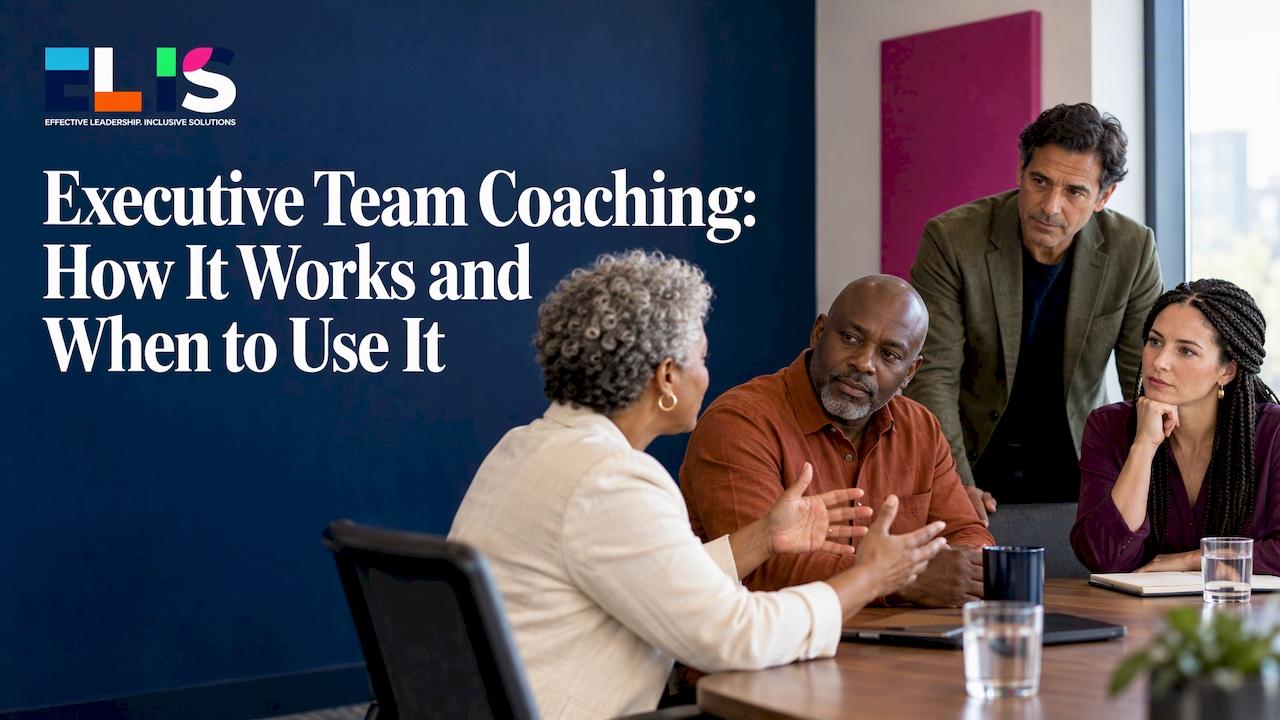
Executive team coaching works with a senior leadership team as one client. The coach helps the team improve how it decides, communicates and leads together, so the group performs as more than the sum of its individual executives. One-to-one executive coaching develops a single leader. Team coaching develops the relationships, habits and shared purpose between leaders, and the two often work best side by side.
This guide explains the difference, the signs that a team is ready, what an engagement looks like, how to measure it and how to choose a coach in Ireland.
Key Takeaways
- The International Coaching Federation (ICF) treats the team itself as the client in team coaching, which sets it apart from coaching an individual.
- Teams benefit most when the work targets trust, decision-making and shared accountability, not only individual skills.
- Psychological safety is the foundation: leaders take the interpersonal risks that honest debate needs only when the team feels safe.
- Agree measures at the start and review them at three, six and twelve months, so the impact is visible to the CEO and HR alike.
- Look for a coach with team-specific training, supervised practice and a systemic, inclusive approach.
Table of Contents
- What executive team coaching is
- Team coaching and one-to-one executive coaching
- Signs your leadership team is ready for coaching
- Trust and psychological safety in the team
- What happens in an engagement
- Measuring the impact
- Choosing a team coach in Ireland
- Our perspective
- Work with ELIS Advantage
- FAQ
- Sources
What executive team coaching is
The ICF defines team coaching as a co-creative and reflective process with a team, its dynamics and its relationships, which inspires members to reach their common purpose and shared goals. The key idea is the client. In one-to-one coaching the client is a person. In team coaching the client is the team as a single entity made up of several people.
The same ICF document asks coaches to keep team coaching distinct from team building, team training, team consulting, team mentoring and team facilitation. That clarity helps you as a buyer. A away-day, a workshop on communication styles and a coaching engagement are different things with different outcomes.
You will see several names for the same work: executive team coaching, leadership team coaching and executive leadership team coaching. All describe coaching a senior group together, usually the CEO and direct reports, over several months.

Team coaching and one-to-one executive coaching
Both approaches build leadership capability. They answer different questions.
| Question | One-to-one executive coaching | Executive team coaching |
|---|---|---|
| Who is the client? | One leader | The whole team |
| Main focus | Personal effectiveness, presence, career challenges | Shared purpose, trust, decisions, collective leadership |
| Where the work happens | Private sessions | Live team sessions, with real agenda items |
| Typical outcome | A leader who acts with more clarity and confidence | A team that leads collectively rather than in parallel |
| Best for | A leader stepping up, or facing a specific challenge | A team facing change, friction or a need to align |
The INSEAD working paper on leadership coaching and organisational transformation notes that when coaching is applied to teams, it leads to a more egalitarian, high-trust interface that goes beyond traditional superior and subordinate relationships. The same paper says team coaching supports a team's performance potential and builds its capacity for self-sustained development.
In practice, many organisations combine the two. Individual sessions help each executive reflect on their own patterns. Team sessions test those insights in the room where the work happens. Our leadership coaching for senior leaders can sit alongside a team engagement for this reason.
Signs your leadership team is ready for coaching
A team does not need to be in crisis. Many of the strongest engagements start with a team that performs well and wants to perform better. These situations often prompt the call:
- A new CEO or a new team. Several leaders need to form one team quickly, with shared ways of working.
- Strategy that stalls in execution. Everyone agrees in the meeting, and then functions pull in different directions.
- Decisions that take too long or get reopened. The team debates the same issue repeatedly. Our guide on improving decision-making in leadership teams explores this pattern.
- Quiet meetings. Some voices dominate while others hold back, and the best ideas never reach the table.
- Growth, restructuring or merger. The team has to lead through change while its own roles shift.
- Leaders who coach well one-to-one but still work in silos. The individual work has helped, and the next gain sits between the leaders.
If two or three of these sound familiar, team coaching is a strong candidate. If the main need is a single leader's development, one-to-one coaching fits well. If the team simply lacks a skill, such as a new financial process, training fits better. A good coach helps you see which of the three, or which mix, serves you.
Trust and psychological safety in the team
Trust is the most common reason leadership teams look for coaching, and psychological safety is how trust shows up in daily work. Amy Edmondson's definition, cited in an Irish academic paper on boards, describes it as a shared belief that the team is safe for interpersonal risk taking. The same paper reports that psychological safety encourages the cognitive conflict seen as essential to effective board processes.
The paper also cites research by Veltrop and colleagues (2021). It found that a psychologically unsafe climate led by a non-participative chair could inhibit even well-qualified and independent directors from monitoring the CEO. The lesson applies to any senior team: when the person at the head of the table shapes the climate, the whole team's candour follows.
Coaching builds this safety through practice, not through slogans. In live sessions the team:
- Names how it wants to disagree, and what it will do when someone feels unheard.
- Works on real issues, with the coach observing patterns that the team cannot see from inside.
- Reflects on what happened and agrees one or two behaviour changes to try before the next session.
For more depth, read what psychological safety means in the workplace and how leaders create psychological safety in teams.
What happens in an engagement
Every engagement is tailored, and most follow a similar arc. Below is a typical shape, which we adapt to each team's context.
1. Discovery and contracting
The coach meets the CEO or team lead, and often HR, to understand the business context and what success looks like. Together you agree scope, confidentiality, how often the team meets and how progress will be reviewed. Getting this stage right matters. Irish research on executive coaching, a doctoral study by Mary Wilcox, found that the most significant gap in evaluation sat between the HR Director and the CEO. Shared goals at the start close that gap.
2. Gathering data
The coach gathers a picture of how the team works now. This can include individual conversations, a team survey, observation of a real meeting and a review of how decisions are made. The data gives the team a shared starting point, grounded in evidence rather than opinion.
3. Team sessions
The team meets with the coach at an agreed rhythm. Sessions work on live business issues: a strategic choice, a difficult conversation, a handover between functions. The coach holds a mirror to the group's dynamics, asks questions and helps the team design its own responses. The team owns the content. The coach owns the process.
4. Practice between sessions
Change happens in daily work. Between sessions leaders try new habits in their real meetings, such as inviting dissent before deciding, or closing a meeting by agreeing who owns each action. They bring the results to the next session.
5. Review and handover
The team reviews progress against the measures set at the start, and agrees how it will keep developing without the coach. The INSEAD paper describes this aim as building a team's capacity for self-sustained development.
Roles in the room
| Role | Responsibility |
|---|---|
| Coach | Designs and holds the process, observes patterns, asks questions, keeps the work focused on the team's goals |
| Team leader (CEO or head) | Models openness, sponsors the work, takes part as a team member |
| Team members | Bring real issues, give and receive honest feedback, practise new habits between sessions |
| HR or sponsor | Helps agree goals, supports follow-through and takes part in reviews |
Measuring the impact
A team that commits months to coaching deserves to see what changed. Yet the ICF and Human Capital Institute research on coaching cultures found that 38% of respondents named the inability to measure impact as a potential obstacle to building a strong coaching culture. The same research found that 54% of organisations with a strong coaching culture are also high-performing, against 29% of those without one.
The ICF suggests looking across timelines, in its piece on coaching ROI and the ripple effect:
| Timeframe | What to look at |
|---|---|
| 3 to 6 months | Team climate surveys, changes in communication patterns |
| 6 to 12 months | Team performance metrics, cooperation across departments |
| 1 to 3 years | Lasting cultural change and systemic changes in how work gets done |
A practical measures set often mixes three kinds of evidence:
- Behaviour: a short pulse survey on trust and candour, repeated at set points, plus the team's own observations.
- Process: time to decision, number of reopened decisions, quality of meeting follow-up.
- Business results: the metrics the strategy depends on, such as delivery milestones, retention of key people or customer outcomes.
The ICF's research portal describes a longitudinal study that followed 30 participants working with six coaches, over an average of 8.67 months per engagement. It collected 360-degree feedback, business performance data and progress against coaching objectives. The approach shows that blending people data and business data gives the fullest picture. A systematic review by Grover and Furnham concluded that coaching is an effective tool that benefits organisations.
Not everything valuable fits a spreadsheet. The ICF notes that new communication habits create waves of change that most ROI calculations do not capture. Pair the numbers with the team's own account of what has shifted.
Choosing a team coach in Ireland
Team coaching is a specialism. Experience with individuals is a strong base, and team work adds further skills. These points help you choose well:
- Team-specific training. The ICF Advanced Certification in Team Coaching asks candidates to hold an ICF coaching credential, complete team coaching education, run several team engagements and receive coaching supervision, then pass an exam. Credentials are one signal among others, and a coach without this exact certificate may still bring deep team experience.
- Supervision. A coach who reflects on their own practice with a supervisor brings more perspective to your team. Our guide to reflective practice in coaching explains why this matters.
- A clear process and measures. The coach can describe how contracting, data gathering, sessions and review work, and how you will see progress. Wilcox's study found some executives were frustrated by a lack of continuity and progress measures, so a visible structure protects your investment.
- A systemic view. Team behaviour sits inside culture, structure and power. Coaches who look at the whole system help changes last beyond the engagement.
- Inclusive practice. Senior teams work best when every voice shapes decisions. A coach grounded in inclusive, trauma-informed and anti-oppressive practice helps the team hear voices it may currently miss.
- Fit with your context. Ask about experience in your sector, whether tech, pharma, education, retail or healthcare, and about working with Irish and international teams.
Our perspective
We see leadership teams every week that are full of capable people and still stuck. The individuals are strong. The system between them, meaning the unspoken rules about who speaks, who decides and what can be said, holds the team back.
That is why we combine data-driven performance work with trauma-informed, anti-oppressive practice. Data shows us where the team's patterns sit. Inclusive, safe facilitation lets the team look at those patterns honestly and change them. Either one alone gives a partial result.
We also believe in fierce conversations held with compassion. A team that can name a difficult truth, stay in the room and agree what happens next performs better and keeps its talent. Our work with executive and leadership teams is built around that kind of accountability, and each engagement is tailored to the team's goals, its context and its people.
Used well, team coaching and individual coaching strengthen each other. Leaders gain personal insight in one-to-one sessions and put it to work in the team.
Sile
Work with ELIS Advantage
We support senior teams through tailored coaching, facilitation and consulting, grounded in psychological and organisational research. Our executive and leadership team interventions are designed around your team's goals, whether that means building trust, sharpening decisions or aligning behind a new strategy.

If you want to pair team work with individual development, our leadership coaching process starts from €2,521 as a one-off engagement, and our twelve-month programmes start from €6,252 per year. You can explore both on the leadership coaching page. To discuss a team engagement, visit our services page and get in touch. For a first step at your own pace, our Inclusive Leadership 101 course gives leaders a shared language for inclusive practice.
FAQ
How long does executive team coaching take?
Most engagements run for several months, with team sessions at an agreed rhythm and practice in between. The ICF study cited above followed coaching engagements lasting 8.67 months on average. We agree the length with you after discovery, based on your goals and the team's context.
Who takes part in the sessions?
The core group is usually the CEO or team lead and their direct reports. HR often joins the contracting and review stages. Everyone who takes part is a member of the client, so the work stays focused on how they function together.
How is team coaching different from team building?
Team building usually centres on a shared activity or event. Team coaching works over time on the team's real business issues and dynamics, and the team leaves with new habits it applies at work. The ICF treats the two as separate disciplines.
Can we combine team coaching with one-to-one coaching?
Yes. Many organisations pair the two. Individual sessions give each leader space to reflect on their own patterns, and team sessions let the group put those insights to work on live issues.
How do we know it is working?
Agree measures before you start, then review at three, six and twelve months. Combine a short team survey on trust and candour with process indicators, such as time to decision, and with the business results your strategy depends on.
Sources
- ICF Team Coaching Competencies
- Leadership Coaching and Organizational Transformation, INSEAD Working Paper 2008-71
- Is a Board of Directors a Team?
- Multiple Understandings of Executive Coaching: An exploratory study of Irish experiences
- Building Strong Coaching Cultures for the Future, ICF and HCI
- ICF Coaching ROI and the Ripple Effect of Work
- ICF research: Effectiveness of Leadership Coaching
- Coaching as a Developmental Intervention in Organisations, Grover and Furnham
- ICF Advanced Certification in Team Coaching requirements
Recommended
- Executive & Leadership Coaching
- Executive Coaching for Leaders: What It Is and How to Choose
- How Do You Improve Decision-Making In Leadership Teams?
- Leadership coaching explained: who it's for and how it works
This article has been produced with information from our work, but uniquely combined and produced with AI support.