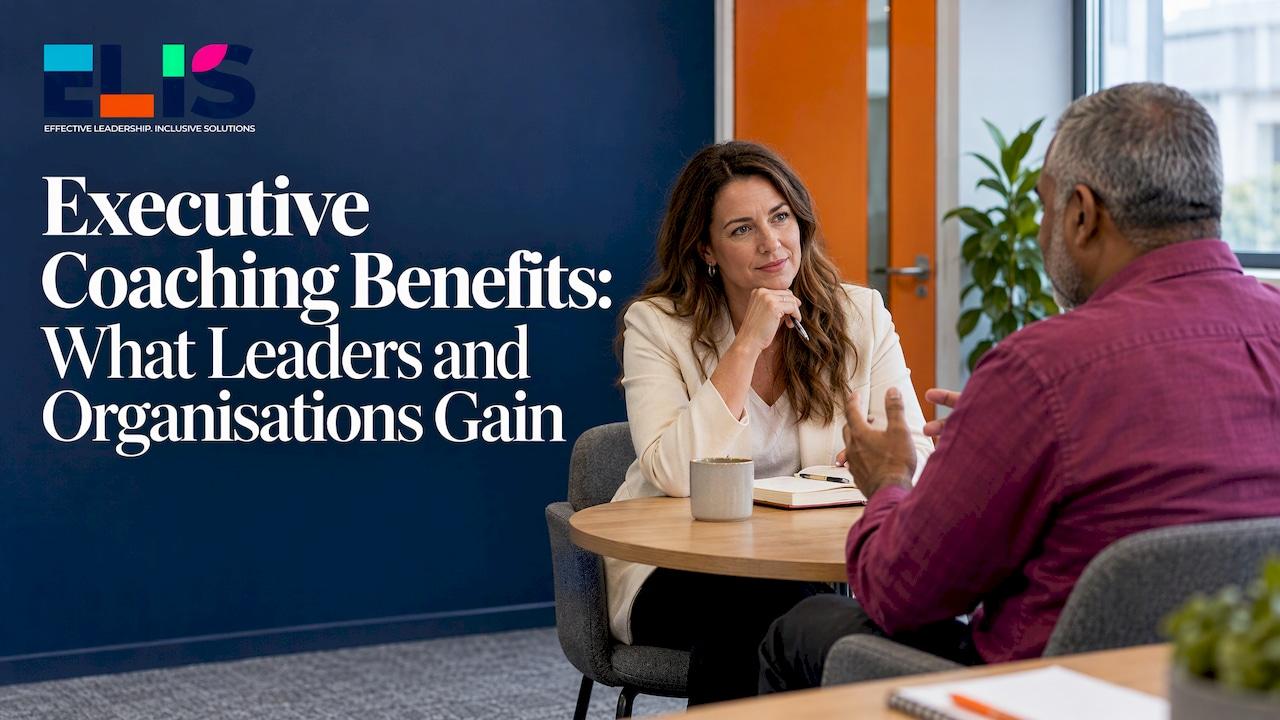
Executive coaching gives senior leaders a confidential, structured space to build self-awareness, sharpen decisions, communicate with more impact and lead their teams through change. The gains reach beyond the individual: stronger teams, better engagement and a deeper leadership pipeline. Research supports this, and the results are strongest when coaching connects personal growth to the team and culture around the leader. That is the approach behind our leadership coaching for senior leaders.
Key Takeaways
- Executive coaching develops self-awareness, communication, decision-making and confidence through one-to-one work with an external coach.
- A 2023 meta-analysis of 37 randomised controlled trials found a moderate positive effect of coaching on leadership and personal outcomes.
- Benefits reach teams and organisations: engagement, change management, leadership development and wellbeing.
- Engagement, retention and team feedback are practical ways to see progress, alongside the leader's own goals.
- Coaching that links the leader, the team and the wider culture turns individual growth into lasting results.
Table of Contents
- What executive coaching is
- Benefits for the leader
- Benefits for teams and the organisation
- What the research says about outcomes
- Who gains most, and what makes the gains last
- How to measure the benefits
- Why systems thinking adds to the benefits
- Executive coaching with ELIS Advantage
- Getting the most from your first sessions
- FAQ
- Sources
What executive coaching is
The American Psychological Association describes executive coaching as one-to-one, customised counselling and feedback that develops managers' interpersonal and managerial skills and helps them reach short-term and long-term organisational goals. It is usually delivered by an external consultant or professional coach.
Two features matter for senior leaders. The work is confidential, so you can say what you would not say in a boardroom. It is also tailored: the agenda comes from your role, your team and the pressures you face this quarter, not from a generic curriculum.
Benefits for the leader
Clearer self-awareness
Self-awareness is the benefit most guides list first, and for good reason. A 2025 guide from American Public University explains that coaching offers a safe, structured space to examine habits, mindsets and blind spots. It describes self-awareness as a foundation of emotional intelligence, driving changes such as spotting blind spots, responding well to feedback and making more conscious decisions.
Senior roles often come with less honest feedback. People around a CEO or COO tend to soften their words. A coach gives you an informed, independent view of how your decisions and habits land.
If you want to explore this area further, our emotional intelligence leadership assessment is a useful starting point.

Better communication and difficult conversations
The same guide notes that leadership coaching helps leaders build rapport with team members and handle difficult conversations with empathy and authority. In practice, coaching sessions become a rehearsal room. You prepare for a performance conversation, a restructure announcement or a disagreement with a peer, then reflect on how it went.
This matters most when the stakes are high. A leader who can say a hard thing clearly and kindly protects both the relationship and the result.
Sharper decisions
Coaching helps you slow down at the right moments. Questions from an outside partner test assumptions, surface options you had not weighed and separate what the evidence shows from what feels urgent. Over time, many leaders find they make fewer reactive decisions and explain their reasoning better to their teams.
Confidence and a steadier sense of self
Many high achievers carry a private doubt that they do not belong at the table. Researchers call this the impostor phenomenon. A 2025 study by Farmer and Papworth of leaders in coaching found that coaching gave participants coping strategies that lasted beyond the programme. The authors also note that more research on this topic is welcome, which tells us the field is still growing.
A coach helps you name the pattern, look at the evidence for and against the doubt, and build habits that keep you steady when a role grows. For a leader in a new position, this is often where coaching pays off first.
Space to think
Leadership can be lonely. Coaching offers a regular, protected hour to think about the business, the team and yourself. It is time you do not otherwise get.
Benefits for teams and the organisation
When a leader changes how they work, the effects travel. The American Public University guide lists improved team dynamics, better decision-making and communication, and support through organisational change among the ways leadership coaching helps companies.
An Irish study points the same way. In 2019, O'Connell studied external executive coaching in the Irish financial services sector, speaking with coaches, senior managers and HR professionals. The National College of Ireland thesis found employees were more effective, motivated and engaged as a direct result of executive coaching. It looked at four areas: performance management, leadership development, change management and organisational wellbeing.
The Institute of Coaching's Executive Coaching Handbook describes coaching as a lever for developing high potentials, retaining top talent, preparing executives for bigger roles and building a leadership pipeline. For an HR director, that links coaching directly to succession and retention.
A table of benefits and where you see them
| Benefit | What it looks like day to day | Where you notice it |
|---|---|---|
| Self-awareness | The leader names their own patterns and asks for feedback | 360 feedback, team conversations |
| Communication | Clearer messages, calmer difficult conversations | Team meetings, one-to-ones |
| Decision-making | Fewer reactive calls, better explained choices | Speed and quality of decisions |
| Confidence | Steadier presence in new or larger roles | Board and stakeholder settings |
| Team engagement | Colleagues feel heard and clear on direction | Engagement surveys, retention |
| Leadership pipeline | Successors grow into wider roles | Promotion and succession readiness |
What the research says about outcomes
The evidence base is growing, and it is encouraging.
- Randomised trials. De Haan and Nilsson's 2023 meta-analysis pooled 37 randomised controlled trials with 2,528 participants. It found a statistically significant, moderate effect (g=0.59) across leadership and personal outcomes. The analysis also found that results do not depend much on how long the coaching assignment lasts, so focused work can carry real weight.
- Workplace outcomes. A 2023 meta-analysis in Frontiers in Psychology by Cannon-Bowers and colleagues found that workplace coaching achieves positive organisational outcomes, in line with earlier meta-analyses. The authors call coaching one of the fastest-growing performance interventions and encourage the field to keep building its research.
- Succession. In an action research study of 281 executives, Thach combined six months of coaching with 360-degree feedback and aimed to double the number of "ready now" succession candidates, from 1.0 to 2.0 per leader. It shows how coaching can be tied to a specific business goal.
A moderate effect size across so many trials means coaching works for a broad range of leaders and settings. The best results come when the goals are clear and the organisation backs the work.
Who gains most, and what makes the gains last
The Institute of Coaching handbook describes three levels of learning in executive coaching:
- Tactical problem solving. Working through a live challenge, such as a difficult stakeholder.
- Generalisable capability. Building skills a leader carries into any situation.
- Learning how to learn. Building the habit of reflection, so the leader keeps growing without depending on the coach.
The handbook presents the third level as the way to prevent long-term dependency. That is a helpful lens when you choose a coach: ask how the work will move you from level one to level three.
Leaders who tend to gain most include:
- High-potential leaders stepping into broader roles.
- New CEOs, COOs and directors adjusting to the weight of the seat.
- Senior teams that need to work better together under pressure.
- High achievers who feel impostor doubt despite a strong record.
- HR leaders who carry the emotional load of others and want structured reflective support.
Three conditions help the benefits last. First, a clear goal agreed at the start. Second, support from the leader's manager or board. Third, a link between the coaching and the leader's real work, so each session feeds into what happens next week. Our article on how to choose an executive coach walks through these points in more detail.
How to measure the benefits
Many leaders ask whether coaching pays back. Grover and Furnham's 2016 review of coaching in organisations reports that only 14% of coaching purchasers used ROI, and that engagement and retention mattered more as metrics. The authors recommend person-centred measures focused on wellbeing and engagement, together with outcomes such as subordinates' satisfaction, retention and performance.
Here is a simple way to apply that:
- Agree two or three goals at the start, in plain language. For example: "Run team meetings where every voice is heard."
- Pick the signals that show progress: engagement scores, retention in the leader's team, 360 feedback, or the quality of decisions.
- Take a baseline before the first session.
- Review at the midpoint and the end with the leader, and with the sponsor where appropriate.
- Ask the team. Colleagues often see changes before the leader does.
This gives you evidence that fits the way coaching works: personal, specific and tied to the people around the leader.
Why systems thinking adds to the benefits

A leader does not work alone. Culture, team habits and organisational systems shape what is possible, and coaching that looks only at the individual can miss these. We find the strongest results come when coaching connects personal development, group dynamics and culture. If your focus is the whole leadership group, executive team coaching applies the same principles to the team as a unit.
Those interested in how leadership grows across an organisation can read how to develop leadership capability across an organisation.
Our perspective
We see executive coaching as the point where research meets the reality of a leader's week. Our approach is grounded in psychological and organisational research, and it is practical, needs-based and sustainable.
The leaders we work with are often high performers carrying real responsibility. They benefit from a space where data and honest reflection sit side by side. We bring data-driven models together with trauma-informed, anti-oppressive practice, so performance and inclusion grow together rather than competing.
We believe a leader's growth lasts when it connects to their team and culture. That is why we link personal development, group dynamics and culture transformation, and why our coaching suits senior teams who are ready for fierce, compassionate conversations.
When a leader builds inclusive habits, the whole workplace gains: people speak up, talent stays and performance rises. This is the benefit we most want for the leaders we coach.
Sile
Executive coaching with ELIS Advantage
Our Effective Leadership Coaching Process starts from €2,521 as a one-off engagement. Our twelve-month programmes start from €6,252 per year. Both are tailored to the leader and built on research, with a focus on inclusive, trauma-informed leadership.

If you are leading a senior team, you can also look at our executive and leadership team interventions. To start a conversation about coaching for yourself or your team, see leadership coaching for senior leaders.
Getting the most from your first sessions
The first weeks set the pattern. A few habits help:
- Bring a real, current challenge to the first session.
- Share your goals with your manager or sponsor, so support is in place.
- Keep a short note after each session: one insight and one action.
- Try one new behaviour each week and reflect on the result.
- Invite feedback from two or three trusted colleagues at the midpoint.
If you want to build emotional intelligence in daily practice, our article on improving emotional intelligence in leadership offers practical ideas. CEOs may also find our guide to CEO coaching useful.
FAQ
What is the point of executive coaching?
The point is to help senior leaders develop the skills, awareness and habits that move them and their organisations towards their goals. It works through one-to-one, tailored conversations with an external coach, as described in the APA Dictionary of Psychology. The benefits show up in how the leader communicates, decides and leads their team.
How is leadership coaching different from executive coaching?
The two terms overlap and are often used interchangeably. Executive coaching tends to focus on senior roles such as CEOs, COOs and directors, while leadership coaching can include leaders at several levels. The benefits are similar: self-awareness, better communication, stronger teams and clearer decisions.
How long does it take to see results?
Many leaders notice new insight within the first few sessions. De Haan and Nilsson's meta-analysis found that effects do not depend much on the length of the assignment, so clear goals and consistent practice matter more than duration. Lasting culture and engagement changes build over months, which is why we offer twelve-month programmes.
Can coaching help with impostor feelings?
Yes. In a 2025 study of leaders, coaching gave participants coping strategies that lasted beyond the programme. A coach helps you name the pattern, test the doubt against evidence and build steadier habits.
How do we know coaching is working?
Agree goals at the start and track signals such as engagement, retention, 360 feedback and team satisfaction. Research on coaching in organisations favours these person-centred measures over a single financial ROI figure.
Sources
- Executive coaching, APA Dictionary of Psychology
- What Is Leadership Coaching and How Does It Help Companies? American Public University
- What Can We Know about the Effectiveness of Coaching? De Haan and Nilsson, 2023
- Workplace coaching: a meta-analysis, Frontiers in Psychology, 2023
- Measuring the Relationship between External Executive Coaching, National College of Ireland, 2019
- The impact of executive coaching and 360 feedback, Thach, 2002
- Coaching as a Developmental Intervention in Organisations, 2016
- Executive Coaching Handbook, 6th edition, Institute of Coaching
- Impostor phenomenon in leaders through the lens of self-efficacy and implications for coaching, 2025
Recommended
- Executive Coaching for Leaders: What It Is and How to Choose
- Executive Team Coaching: How It Works and When to Use It
- CEO Coaching: What It Is and How to Choose a Coach
- Executive & Leadership Coaching
This article has been produced with information from our work, but uniquely combined and produced with AI support.